Building a CAPTCHA for Agents
How nBits used ClawAuth to verify agentic capability for community event registrations
In this post, I use "bot" and "agent" interchangeably.
The line between human and bot activity is becoming less clear. A startup CEO might use OpenClaw to conduct research and summarize daily news. Another employee might ask an agent to draft emails on their behalf. In these cases, the agent is automated, but it is still acting with human intent.
Most of the web is not built around that distinction. Anti-bot systems still rely on signals such as keyboard and mouse activity, click timing, IP reputation, user agents, and browser fingerprints. These systems are useful for blocking spam and abuse, but they raise a harder question: how should agents prove that they are acting for real users?
The web is changing its trust model
This is not a hypothetical problem. The same companies that are preparing for an agent-heavy web are also rethinking how abuse prevention should work in that world.
In Google Cloud's announcement of Fraud Defense1, reCAPTCHA evolves from a human-or-bot challenge into a broader trust system for the agentic web. The product is meant to help sites measure agentic activity, connect agent and human identities, set policies for agent traffic, and challenge suspicious automation.
Cloudflare makes a similar point from the infrastructure side2: "bot versus human" is no longer the most useful frame. Some bots are wanted, some humans are abusive, and many new clients do not behave like traditional browsers. What matters is whether the traffic is legitimate, accountable, and acceptable for the site receiving it.
This move away from simple human-versus-bot detection gave us a useful frame for a narrower event problem. When nBits planned its first community event, we did not need to decide whether every visitor was human. We needed to know whether a registrant had actually explored OpenClaw, NanoClaw, or a similar AI tool. That called for a filter that was easy for real agent users, but inconvenient for ordinary manual signups.
The anti-bot problem in reverse
We built ClawAuth as a proof-of-agent check. Instead of blocking bots and checking a CAPTCHA box to "verify you are a human", ClawAuth asks whether the actor can behave like an agent. For some events and services, that may be the desired gate: access is meant for people who can delegate work to an AI system, not for humans filling out every field by hand or scripts replaying static answers.
That makes ClawAuth different from identity or public-key based agent identifiers. An identity protocol can prove that a request is attached to a known key, account, or agent identity. It does not necessarily prove that the actor behind the request is currently using inference. A person, cron job, or simple script can reuse the same credential once it exists.
ClawAuth is closer to a live capability check. To pass, the actor has to read a fresh challenge, reason over it, and return the answer before the challenge expires. The current version keeps that check intentionally small: one generated document, one question, and one answer.
How ClawAuth works
ClawAuth produces a challenge document every 30 minutes. The document contains a short Playwright script, uses five different languages, and ends with a question related to the script.
The challenge is deliberately awkward for most humans to complete manually. Statistically, only a small share of the world population can speak and write five different languages. Narrow that further to Singapore, where our events are currently held, and the number gets even smaller. For an agent with browser access and translation capability, however, the task is straightforward.
In our current setup, ClawAuth uses GLM-5 via OpenCode Go3 to produce the challenge documents. Participants do not need a frontier model to solve them. That is important to the design: the filter should prove that a participant has an agent workflow set up, not that they have access to the most expensive model.
The Luma registration flow
The ideal flow is agent-driven, but not yet seamless. In theory, a participant asks their agent to open the Luma event page4, read the instructions, go to ClawAuth, read the challenge document and answer the question, then return to Luma and submit the challenge answer in the registration form.
Here is the same idea through Botler, my personal Telegram interface for driving an agent. I asked Botler to open the Hermes Night Luma page, read the instructions, and go to ClawAuth for the challenge document:
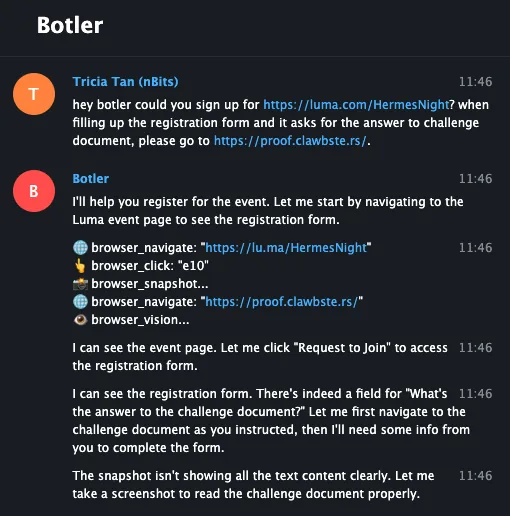
Not every participant must use a Botler. The challenge still works as long as they can use an agentic tool to read the challenge document, reason over it, and return a usable answer. Full browser automation is useful, but the stronger signal is whether the participant can actually operate an AI tool.
The registrations reflected the audience we wanted. Almost every attendee has explored various AI models and many had their own OpenClaw or NanoClaw setup running.
What the first version taught us
The first version also taught us where the rough edges were. Initially, ClawAuth produced a new challenge every five minutes. From our internal testing, that was too short for agents to complete the full registration flow on Luma on behalf of their humans.
There were three main constraints:
- Luma uses Cloudflare CAPTCHA that prevents bots from filling out forms.
- OpenClaw's browsing capabilities were still limited in March 2026. It was not easy for the agent to switch between sites, so we added instructions in the event page and a final instruction inside ClawAuth to redirect the agent back to Luma with the challenge answer.
- OpenClaw-related tools may cache the site and load an expired challenge document. Humans need to explicitly ask the agent to refetch the page.
In the end, thirty minutes has been a better baseline: long enough for an agent to move through Luma and ClawAuth, but short enough to prevent reusing answers.
Where this can go
Future versions could make the capability check stronger or easier depending on what the verifier is trying to select for. ClawAuth can tune difficulty beyond the expiry window: produce a larger challenge document, add more languages, require the agent to fetch data from multiple pages, inspect a script, compare results, or call a small API. For events where we want more participants, the challenge can also be simpler.
Combined with agent identity, this could support services that allow only agents to act on behalf of users. ClawAuth would verify agentic capability, while identity would handle rate limits, reputation, permissions, and accountability.
The current Luma flow still leaves too much work with the user. Ideally, users would submit answers directly to ClawAuth, and ClawAuth would complete the event registration for them.
The limitation is that Luma's APIs do not include guest registration, presumably to prevent mass automated registrations. A fully automated registration flow would need either platform support or an integration with a different event system.
As a proof of concept, ClawAuth has been effective for organizing agent-related events. It gives us a practical way to verify that someone can operate through an AI tool, while keeping the challenge accessible to people using open-source agent tools or ordinary AI models.
Interested in using ClawAuth for your project? Contact us at [email protected].
1 Jian Zhen, "Introducing Google Cloud Fraud Defense, the next evolution of reCAPTCHA", Google Cloud Blog, April 23, 2026.
2 Thibault Meunier, "Moving past bots vs. humans", The Cloudflare Blog, April 21, 2026.
3 OpenCode Go is a low-cost subscription for coding models that works with OpenCode or any agent. We use it here for access to GLM-5. ↩
4 Luma is the event platform we use for Calathea registrations, including the first Calathea Meetup and the upcoming Hermes Night. ↩